OBAs
Synonyms: Optical Brightening Agents (OBAs), Optical Whiteners, Fluorescent Brightening Agents (FBAs), Fluorescent Brighteners, Fluorescent Optical Brighteners, Fluorescent Whitening Agents (FWAs), Fluorescent White Dyes, and Organic Fluorescent Dyes
What are OBAs?
Optical Brightening Agents (OBAs) are chemical compounds that give a whitening effect to the substrate/fabric. They absorb light in the ultraviolet (UV) and violet regions and re-emit it in the blue region.
This phenomenon is called fluorescence and is the reason for many color issues.
This blue light emission reduces the yellow color of the substrate and gives a brightened look. But this impression is caused by a non-visible component of the light (UV). Unlike bleaching, it doesn’t leave a yellowish tinge and gives a much pleasing whiter-than-white appearance.
The effect of the visual appearance is dependent on the SPD curve of the illumination, if the illumination has UV components, it will excite and enhance the blue emission; if the illumination has no UV, then the effect of the blue emission will be minimal. Learn more about OBAs
Due to their properties, OBAs are widely used in industries such as:
- Paper
- Textiles
- Plastics
- Cosmetics
In other words, OBAs use the process of fluorescence to trick your eyes into believing your papers, plastics, and textiles (clothes) are whiter and brighter than they actually are.
Importance of UV components in the light
UV component is invisible to humans, but some chemical substances have the ability to convert UV into visible light.
Optical Brighteners Agents (OBA's) are typically used to create the illusion of brighter and more "fresh" white paper or textile...
| no UV | Light with UV |
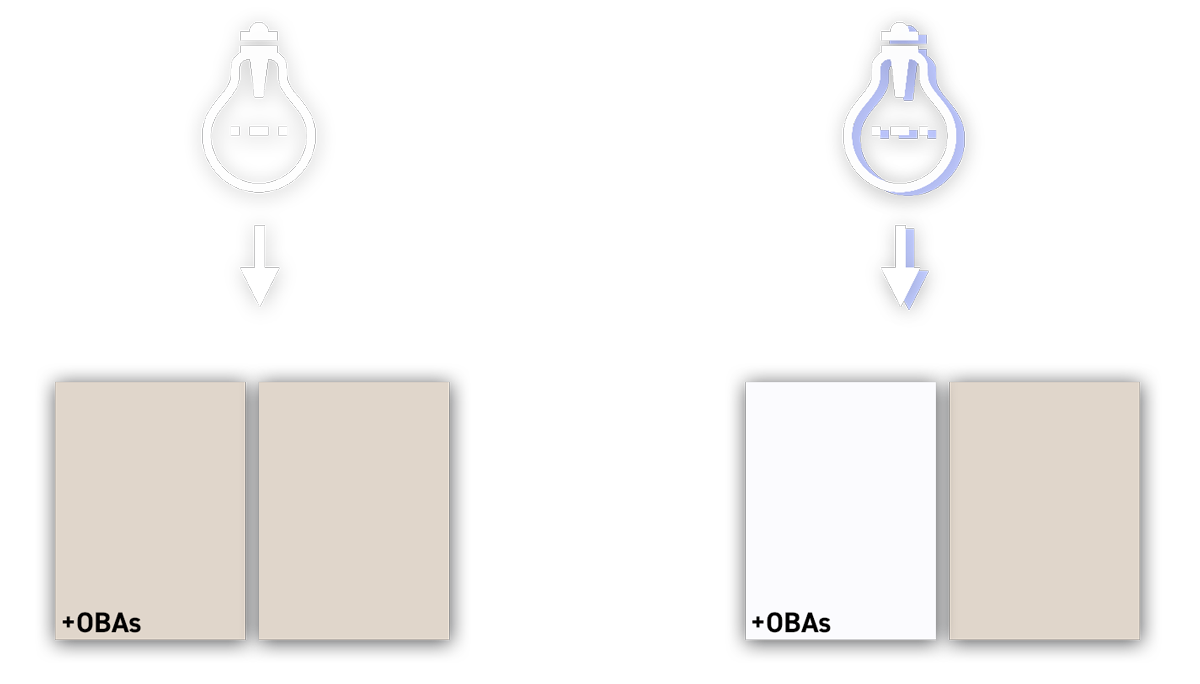
If we have two sheets of paper, one with and one without OBAs - when exposed to visible light only - both can look the same, But if a UV component exists, this will boost the blue part changing the visual appearance.
___________
Are your Instruments capable of measuring both M0 and M1? Many older instruments don't support M1 measurements that are, in most situations, better. Upgrading to M1 might be expensive, and therefore, it is not a simple decision. We should take into account the following:
- We need M1 when printing on substrates that contain OBAs, and it is in the case of most low-price substrates. UV light will change the appearance of the substrate white point - and the instrument should follow the same phenomena that the human eye can observe.
- If, in our workflow or as aim points, we are using modern ICC profiles/characterization datasets - they are created based on M1 data and should be mixed with older M0.
- Remember not to mix measurements made with different M-conditions - if OBA's existing data will not match.
- Some measurements require double M-condition data for evaluation - e.g., OBA's Index requires M1 and M2 data to be compared.
How do we detect and measure the number of OBAs?
Related Topics
Contact ChromaChecker Support
Additional information and Support Form is available for logged users.